No products in the cart.




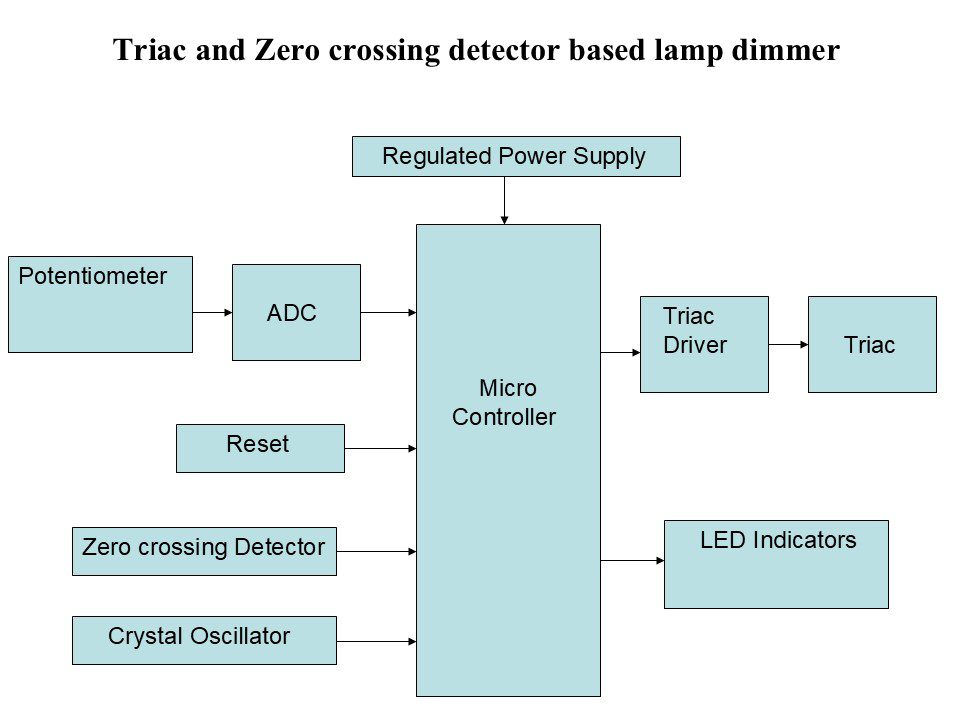
The Triac and Zero Crossing Detector Based Lamp Dimmer is an electronic system designed to control the brightness of an AC lamp efficiently. The system uses a microcontroller, zero crossing detector, TRIAC driver, and TRIAC to regulate the power supplied to the lamp. A potentiometer is connected to the ADC of the microcontroller to allow the user to adjust the desired brightness level.
The zero-crossing detector synchronizes the microcontroller with the AC mains waveform, enabling accurate phase-angle control. Based on the potentiometer input, the microcontroller generates the appropriate firing delay for the TRIAC, thereby increasing or decreasing the lamp brightness smoothly. LED indicators are provided to indicate the system status.
This project offers a simple, reliable, and energy-efficient solution for AC light intensity control. It is suitable for residential lighting, industrial illumination control, stage lighting, and other applications requiring adjustable lamp brightness.
The main objectives of the project are:
 Block Diagram:
video:
Block Diagram:
video:
To control the brightness of an AC lamp using a TRIAC and phase-angle control technique.
To detect the AC zero-crossing point for accurate and smooth TRIAC triggering.
To adjust the lamp intensity using a potentiometer connected to the microcontroller's ADC.
To provide an energy-efficient and reliable lamp dimming system.
To indicate the operating status of the system using LED indicators.
The major building blocks of this project are:- Regulated Power Supply.
- PIC Microcontroller.
- Triac with driver.
- Zero crossing Detector.
- Crystal
- Potentiometer
- Reset Button.
- LED Indicators.
- PIC-C compiler for Embedded C programming.
- PIC kit 2 programmer for dumping code into Micro controller.
- Express SCH for Circuit design.
 Block Diagram:
 video: