No products in the cart.



Wireless sensor networks (WSNs) are effective for locating and tracking people and objects in various industrial environments. Since energy consumption is critical to prolonging the lifespan of WSNs, we propose an energy-efficient LOcalization and Tracking (eLOT) system, using low-cost and portable hardware to enable highly accurate tracking of targets. Various fingerprint-based approaches for localization and tracking are implemented in eLOT. To achieve high energy efficiency, a network-level scheme coordinating collision and interference is proposed. On the other hand, based on the location information, mobile devices in eLOT can quickly associate with the specific channel in a given area, while saving energy by avoiding unnecessary transmission. Finally, a platform based on TI CC2530 and the Linux operating system is built to demonstrate the effectiveness of our proposed scheme in terms of localization accuracy and energy efficiency.
Most existing localization schemes can be broadly categorized into range-free and range-based approaches. Range-free approaches use metrics such as connectivity or hop counts to landmarks, or a radio map of the environment in study and then choose the one best matching the reference as the estimated position. Generally, there exist two types of matching schemes, i.e., deterministic and probabilistic. Deterministic matching schemes compare the scalar values of some measures, e.g., the received signal strength (RSS), between the real-time values and those stored in the database and then select the location
based upon, e.g., the K-nearest neighbor (KNN) and WKNN. In probabilistic matching schemes, the location with the highest probability in the radio map is chosen, e.g., the minimum mean square error . Many experiments have demonstrated that such approaches offer good accuracy for both indoor and outdoor environments.
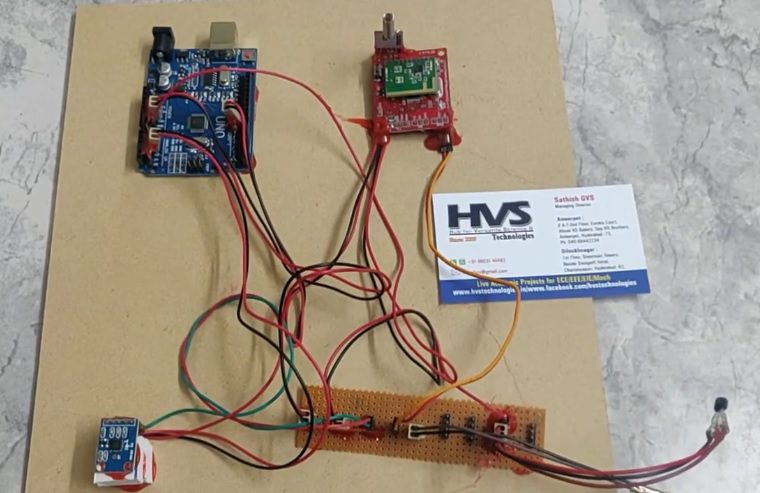
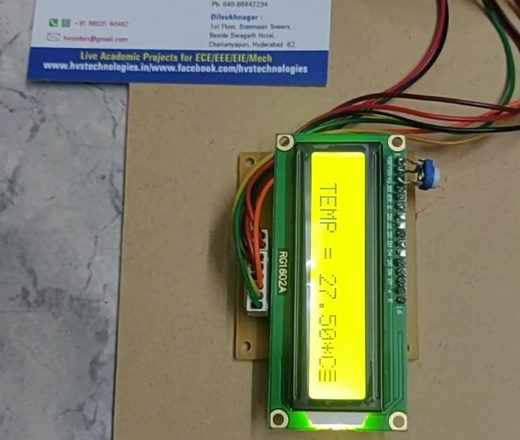
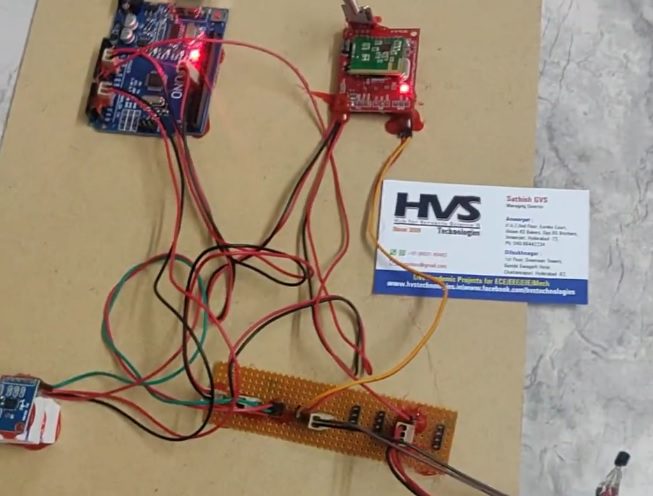
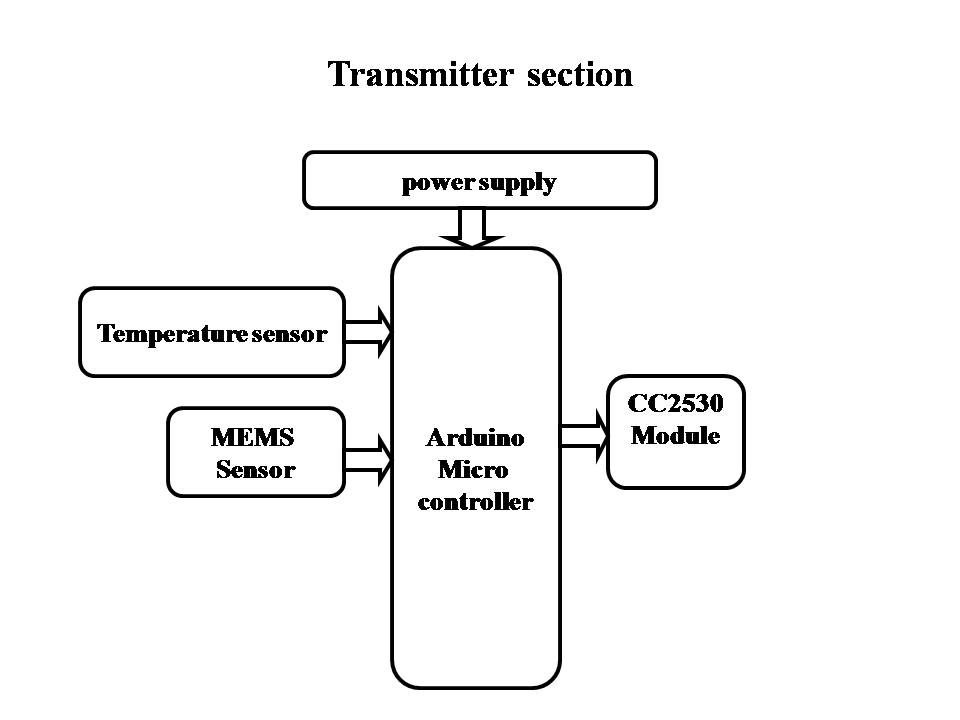
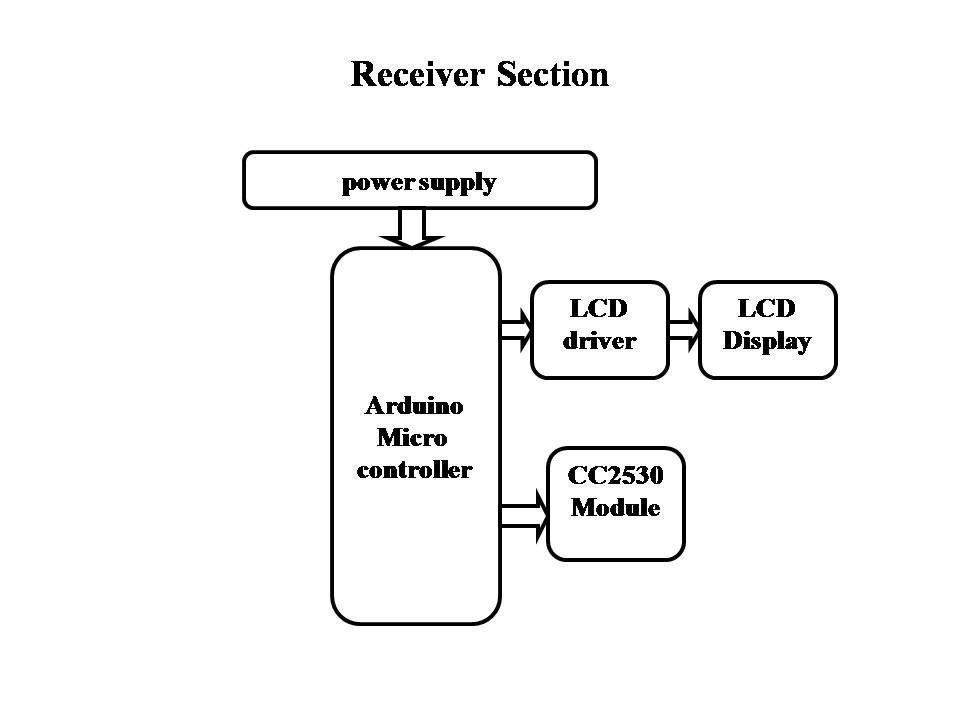
In this project we implement above system using Arduino Uno and CC2530 modules. We have one transmitter section and one receiver section. In transmitter section we are using temperature sensor, MEMS sensor to detect the temperature and tilt values and these values are display on LCD screen. Also CC2530 will sends the signals periodically in-order to improve the energy efficiency, this particular signal with received by the CC2530, which is connected at receiver end. In order to localize the transmitter we have two possible solutions which we discussed above, i.e., deterministic and probabilistic. Here we are going to implement deterministic matching schemes. Based on the received signal strength by arduino, between the real-time values and those stored in the database will localize the transmitter with approximate location name on LCD screen.
 video:
Objectives:
- To design and develop an energy-efficient wireless sensor network using Arduino Uno and CC2530 modules.
- To monitor temperature and tilt values using temperature and MEMS sensors.
- To display the sensed parameters and system information on an LCD display.
- To transmit sensor data periodically using CC2530 wireless communication while reducing unnecessary energy consumption.
- To measure the Received Signal Strength (RSS) of the transmitted wireless signals.
- To implement a deterministic fingerprint-based localization method using stored RSS values.
- To estimate the approximate location of the transmitter by comparing real-time RSS values with the reference database.
- To display the localized/estimated location name on the receiver-side LCD.
- To provide a low-cost and portable localization and tracking system suitable for industrial and indoor environments.
- Micro controller – Arduino Uno.
- Power supply.
- LCD display with driver
- LED Indicators.
- CC2530
- Temperature sensor.
- MEMS sensor.
- Embedded C programming.
- Arduino Studio.
- Express SCH for Circuit design.
 video: