No products in the cart.


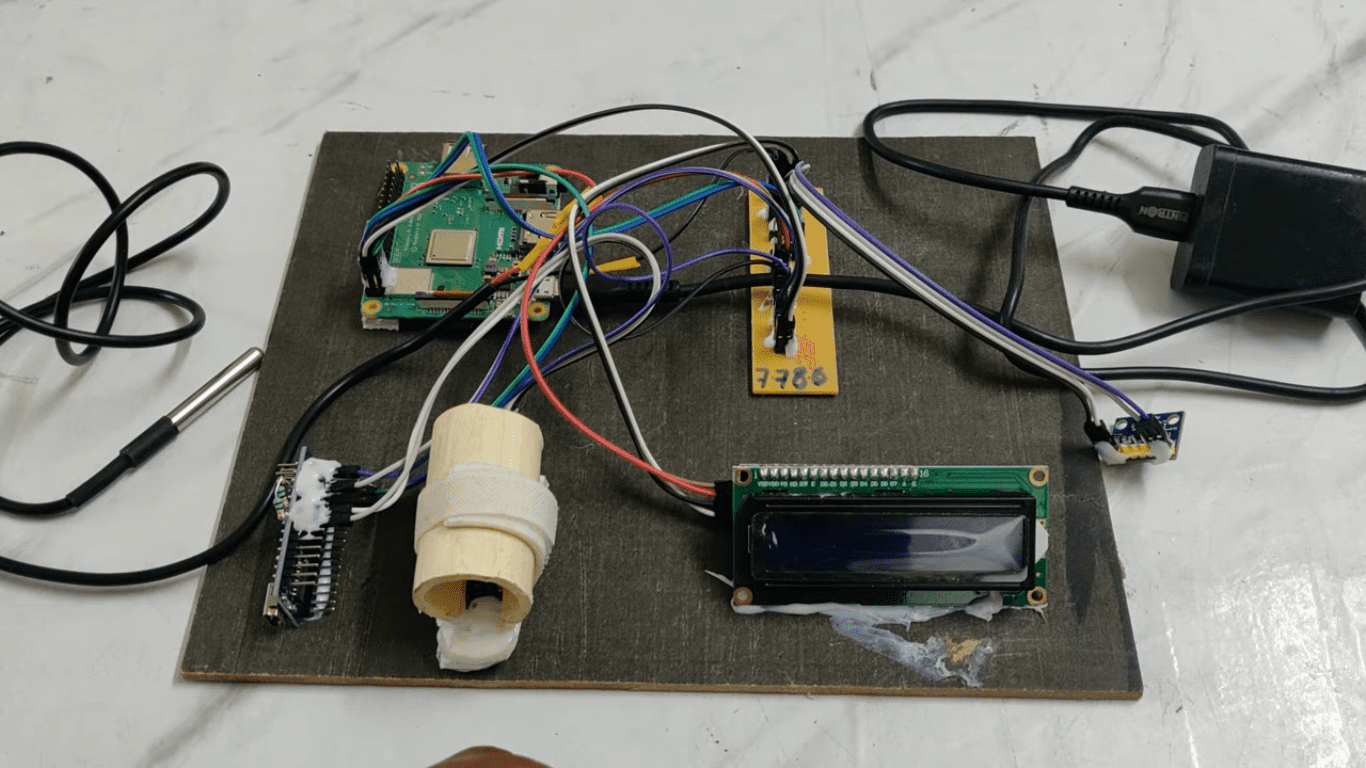
This project proposes a non-invasive hemoglobin measurement system that accurately estimates blood hemoglobin concentration using seven proven optical wavelengths and advanced signal processing techniques. The system employs exactly seven LEDs operating at 450 nm, 530 nm, 560 nm, 590 nm, 650 nm, 730 nm, and 895 nm, which are selected based on established hemoglobin absorption characteristics. The 450 nm (Soret band) and 530–590 nm (Q-bands) provides strong hemoglobin absorption proof, while 650–700 nm wavelengths compensate for melanin effects, 730 nm estimates tissue path length, and 895 nm normalizes blood volume, thereby validating the necessity of using seven wavelengths for accurate non-invasive measurement.
An Arduino Nano is used to precisely control the LED sequencing and perform analog-to-serial conversion, ensuring synchronized acquisition of seven wavelength signals every 100 ms. The collected data are transmitted to a Raspberry Pi 3 A+, where signal separation and processing are performed using Python. Hemoglobin estimation is achieved using the Non-Negative Least Squares (NNLS) algorithm, which fits the multi-wavelength data to known hemoglobin absorption models, providing mathematically constrained and physically meaningful results. A machine learning–based correction stage further refines the output to compensate for noise, physiological variations, and sensor non-linearity, eliminating the need for gender-based calibration.
To ensure best signal-to-noise ratio (SNR), the system maintains an SNR range of 18–25 dB, which is continuously calculated from the AC (pulsatile) and DC (baseline) components of the optical signal, serving as experimental proof of signal quality. Measurements are only accepted when the finger clip encloses approximately three-fourths (¾) of the finger, ensuring sufficient optical path length and stable contact, which is critical for consistent absorption readings.
Additionally, motion and temperature sensors are integrated into the system to improve reliability. An accelerometer detects finger or device movement and flags unstable conditions, while a DS18B20 temperature sensor monitors local temperature to account for thermal variations. All parameters—including hemoglobin concentration, SNR, temperature, and motion status—are displayed in real time on a 16×2 LCD. The proposed system delivers a safe, reusable, gender-independent, and high-SNR non-invasive hemoglobin monitoring solution, suitable for real-time screening and continuous health assessment applications.
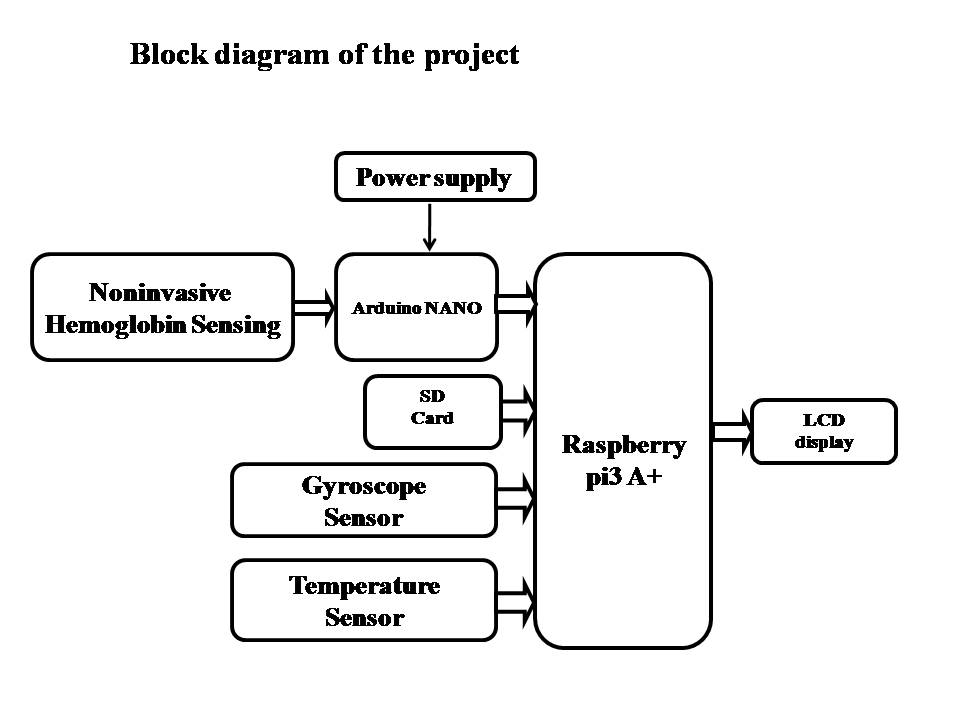
The major building blocks of this project are:
 video:
- Power supply.
- RASPBERRY pi3 A+.
- Arduino NANO.
- Noninvasive Hemoglobin Sensor.
- LCD display.
- Gyroscope.
- Temperature sensor.
- SD card.
- Arduino IDE.
- Embedded C language.
- Raspbian OS.
- Python Language.
- Machine Learning.
 video: