No products in the cart.


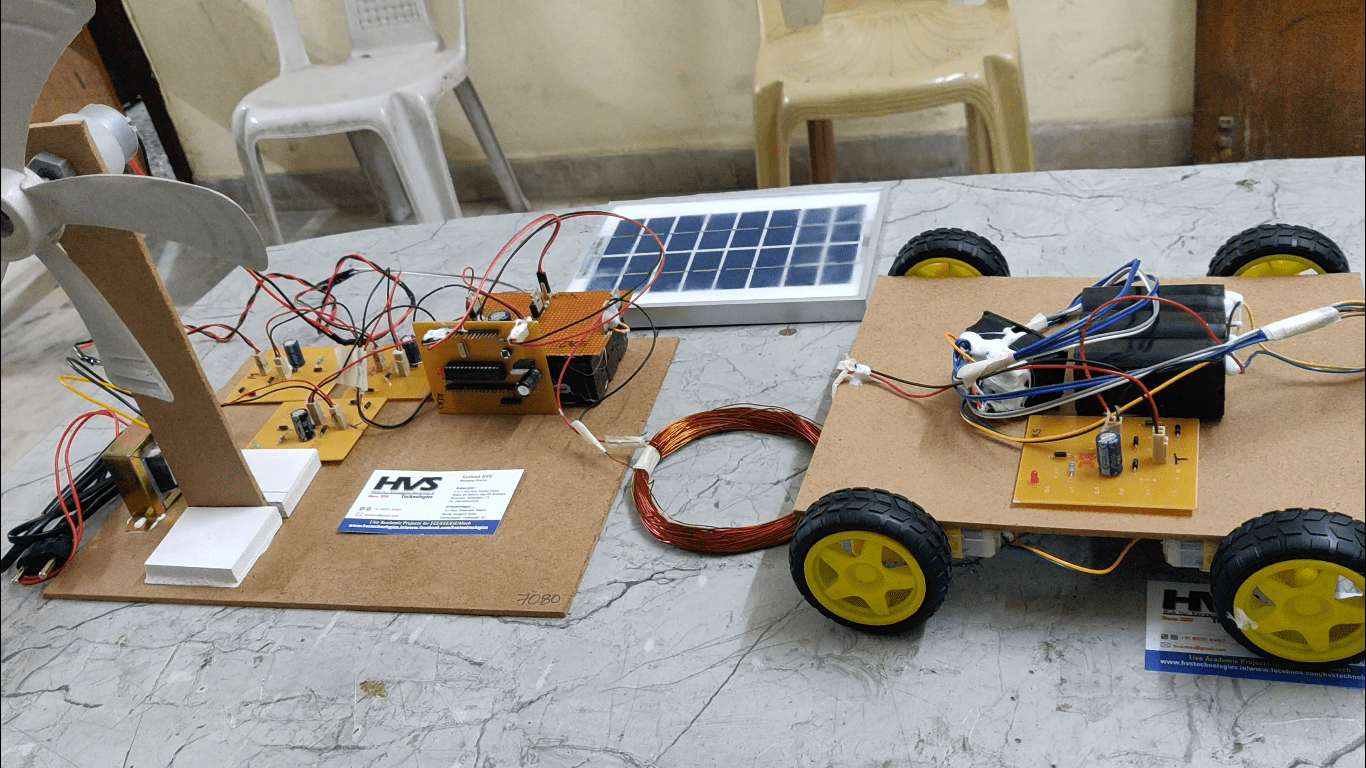
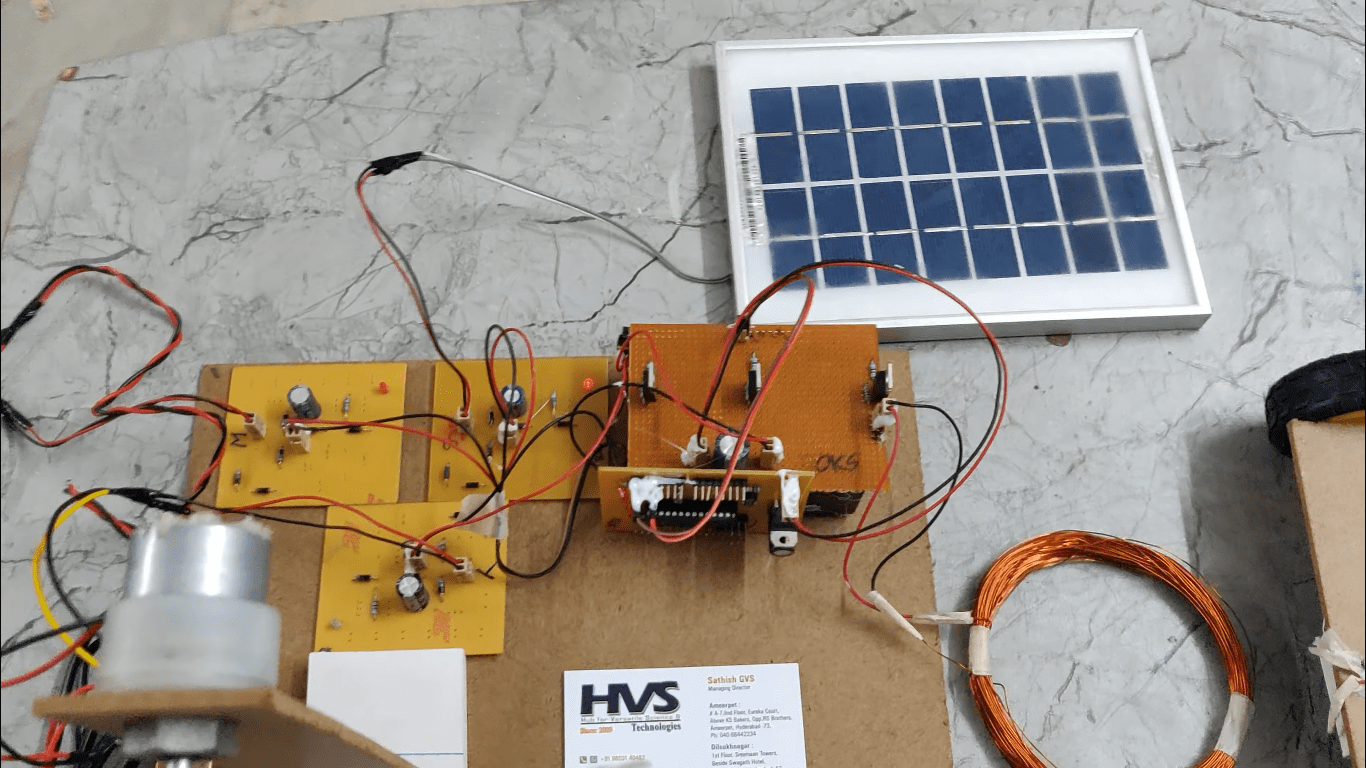
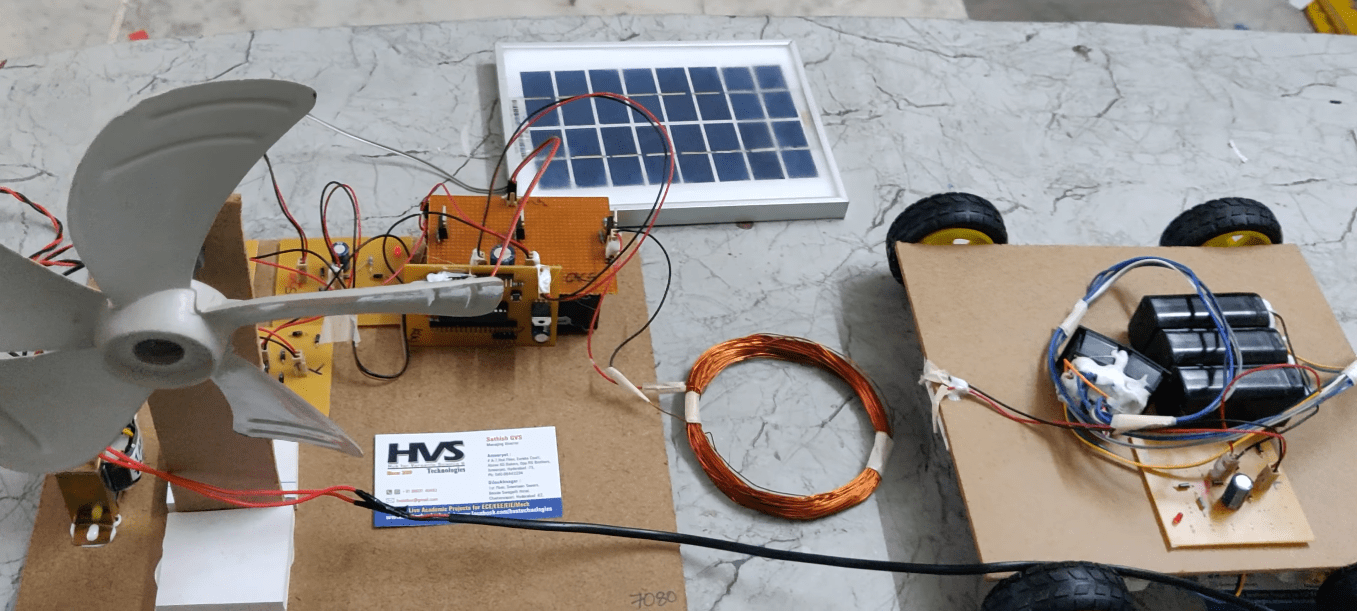
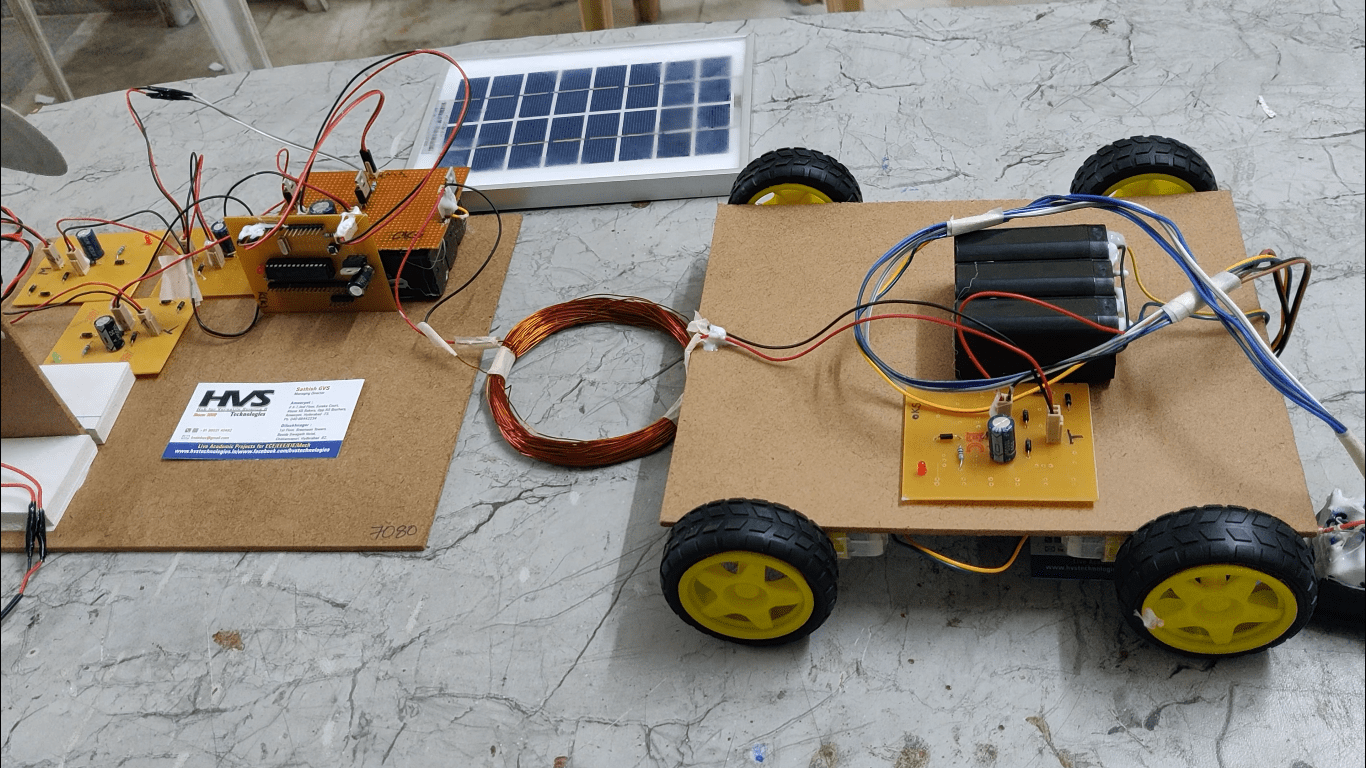
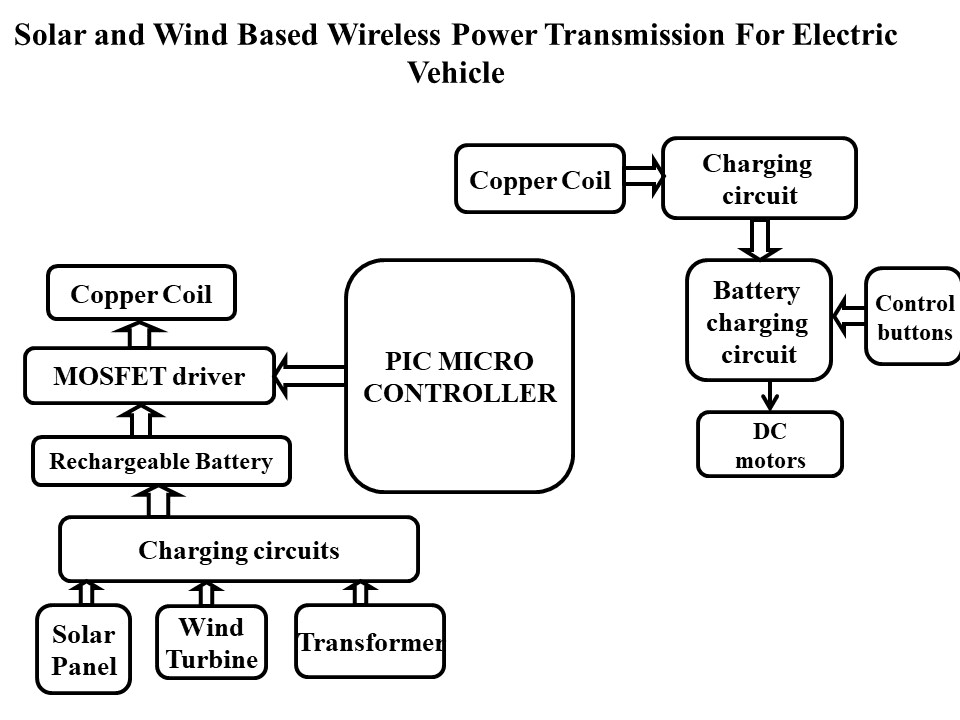
The project aims at developing an intelligent Electric Vehicle (EV) powered by wireless power transmission. In the transmission section, we use solar, wind, and transformer-based systems to charge the battery that powers the transmitting coil. The receiver section consists of the vehicle, which receives power from the transmitting coil while in motion. The received power is stored in the EV battery. The vehicle's operation is controlled by a PIC microcontroller, which manages the power distribution to the DC motors through wireless power transmission.
Achieving a balance between power consumption and power production is a significant challenge today. The most effective solution is to utilize solar energy as efficiently as possible. A key problem in using solar energy lies in the need to position solar panels to maximize sunlight exposure. Fixed solar panels only receive optimal sunlight at certain times, but by dynamically adjusting the panel's orientation, the solar energy generated can be increased. This project integrates a PIC microcontroller to track the sun’s position and automatically adjust the solar panel to maintain maximum energy absorption.
Wireless energy transfer, or wireless power, refers to the transmission of electrical energy from a power source to an electrical load without a physical connection. It is particularly useful where interconnecting wires are inconvenient, hazardous, or impossible. In this context, the wireless power transmission system differs from wireless communications, where the main concern is the signal strength. In wireless power transmission, efficiency is critical; a substantial portion of the energy transmitted must be received to make the system viable.
The system employs two self-resonating copper coils of the same resonating frequency. One coil is connected to the power source (transmitter), while the other is connected to the device (receiver). The electric power from the power source causes the transmitting coil to oscillate at a specific frequency, creating a magnetic field that induces oscillations in the receiving coil, which is tuned to the same frequency. This phenomenon, known as coupled resonance, is the principle behind Tesla's wireless power transmission. The electricity is transmitted wirelessly through the copper coils, with the system designed to transfer power over a distance of about 10 cm.
A PIC microcontroller is incorporated into the system to regulate power flow, ensure efficient energy transfer, and control the vehicle’s movement. The microcontroller interfaces with the receiver circuit, which includes a rectifier and regulator, to convert the AC voltage to DC voltage. This DC power is then used to charge the EV battery, enabling the vehicle to operate efficiently using solar, wind, and wireless energy sources.
Features:
 video:
- Wireless Power: Transmits energy via resonant induction.
- Energy Sources: Solar, wind, transformer.
- PIC Microcontroller: Controls power, motors, and vehicle.
- Solar Tracking: Adjusts panel for optimal sunlight.
- High Efficiency: Minimizes energy loss.
- Resonant Coupling: Transfers power up to 10 cm.
- Power Conversion: AC to DC for battery charging.
- Conversion of AC supply to DC supply.
- Solar panel working principle.
- Wind turbine working principle.
- Resonant frequency.
- Pulse generation techniques.
- Step down transformer.
- Pic micro controller.
- Function generator ic’s like (8038, 1458, xr2206)
- Mosfet drivers.(irfz44, irf540,irf9140, irfp150)
- Two copper coils.
- Regulated power supply (db107 bridge rectifier, capacitor filters 1000uf, regulators 7812)
- DC motors with driver circuitry
- Control Buttons
- Rechargeable battery
- Solar Panel
- Charging circuit.
 video: